
Slab leak water damage in San Diego
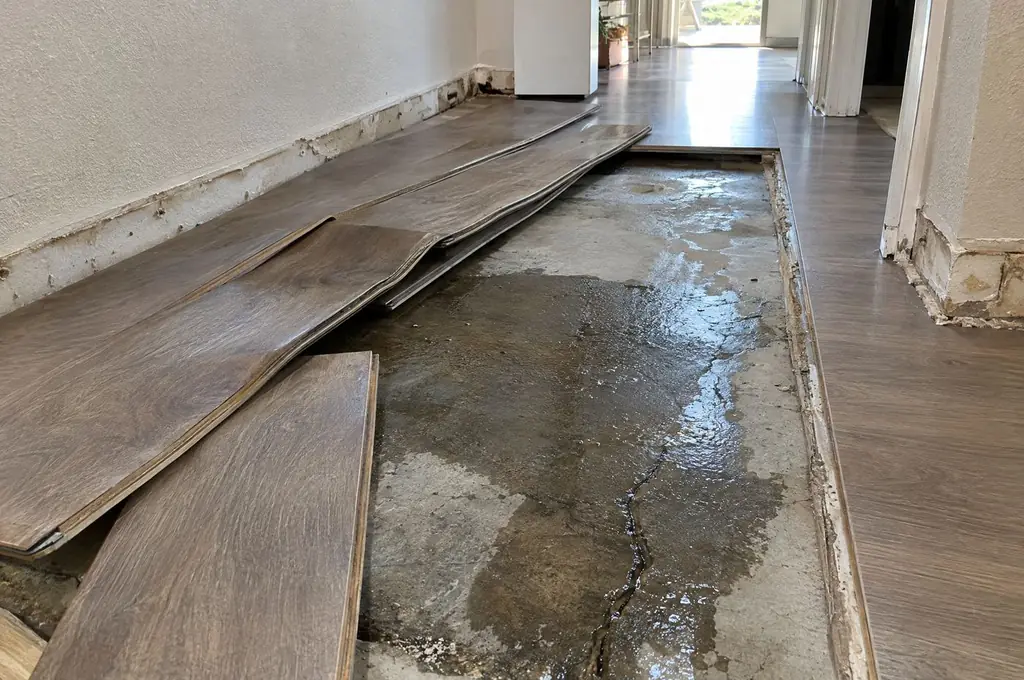
Slab leak signs in a San Diego home are a warm or damp patch on tile or laminate, a water bill that jumps, and a meter that keeps turning with every fixture off. A plumber finds and fixes the pipe; the water damage work dries the slab, floor and walls around it before mold starts.
Your call is connected with an independent local water damage company that works in San Diego. Water category: category 1 (clean water) when caught early.
Everything from the City's meter to your house is yours to repair, the City says. It also requires a pressure regulator where street pressure tops 80 psi, and names a failing regulator as the most common reason pressure suddenly climbs, which is hard on older copper lines.
Right now
- 1Close the house shutoff valve. A leak on the City's side of the meter goes to 619-515-3525.
- 2If the warm spot is on a hot line, turn off the water heater's supply and its gas or power.
- 3Check the meter: with every tap off, a moving dial or leak indicator means water is still flowing.
- 4Pull up wet rugs and move furniture off damp flooring.
- 5Photograph the wet spot, the meter and the water bill.
San Diego facts for this problem
The City repairs leaks on its side of the water meter; a leak on the property side is the owner's to repair.
The California Plumbing Code requires a pressure regulator where street pressure tops 80 psi, the City says, and the regulator is the property owner's responsibility.
Source: City of San Diego: Your Meter, Water Pressure and Plumbing System.
The City names a faulty regulator on the property as the most common cause of a sudden increase in water pressure.
Source: City of San Diego: Your Meter, Water Pressure and Plumbing System.
To check for a leak, the City says to turn off every faucet and water-using appliance and look at the meter; if it still turns, there is probably a leak.
Source: City of San Diego: Your Meter, Water Pressure and Plumbing System.
The California Department of Insurance lists water damage from seepage or leaks among the losses homeowners policies generally exclude, while sudden and accidental water damage is generally covered.
Source: California Department of Insurance: Residential Insurance, Homeowners and Renters.
Census estimates for ACS 5-year 2020-2024 put about 53% of the homes in the 30 ZIP codes mostly inside San Diego city limits as built before 1980.
Source: U.S. Census Bureau, ACS 5-year, tables B25034 and B25035, calculated by San Diego Water Damage Watch on November 14, 2026.
Among San Diego's home ZIPs, 92106 has the oldest median year built, 1958, and 92101 the newest, 2004 (Census ACS 5-year).
Source: U.S. Census Bureau, ACS 5-year, tables B25034 and B25035, calculated by San Diego Water Damage Watch on November 14, 2026.
The City repairs leaks on its side of the meter; everything from the meter to the house is the owner's. It also requires a pressure regulator where street pressure is over 80 psi and names a faulty regulator as the most common cause of a sudden pressure jump.
Sources: City of San Diego: Checking for Meter Leaks; City of San Diego: Your Meter, Water Pressure and Plumbing System
Related on this site: the flood map by ZIP for the median year built in your ZIP, and the printable first-hour sheet for the meter test and who owns which pipe.
The job, step by step
Plumbing repair
A licensed plumber locates and repairs or reroutes the line.
Your part: Ask the plumber for the leak location in writing.
Map the moisture
Meters trace how far the water spread under flooring and up walls.
Your part: Show where you first noticed the floor change.
Remove
Cupped laminate or wood and wet baseboards come up to expose the slab.
Your part: Keep a sample of the flooring for matching.
Dry the slab
Concrete dries slowly; dehumidifiers and air movers run with daily readings.
Your part: Leave equipment on until readings are dry.
Restore
New flooring goes down only after the slab is dry. Work of $1,000 or more needs a CSLB-licensed contractor.
Your part: Check the license number first.
How insurance usually treats it
The California Department of Insurance lists sudden and accidental water damage among perils homeowners policies generally cover and water damage from seepage or leaks among the usual exclusions. A slab leak that ran for weeks can fall on the excluded side, and the pipe repair itself is often treated separately from the damage it caused. Check your policy's wording.
General information, not insurance advice; the policy itself decides. More on the California water damage insurance page.
What changes the size of the job
- How many days or weeks the slab leak likely ran
- Flooring type: tile, laminate or wood
- How much of the slab and walls got wet
- Access: rerouting through walls or attic versus opening the slab
- Drying days for concrete
No prices on this site. A company measures moisture on site and writes an itemized estimate; the water damage estimator lists what that estimate should include.
Questions people ask about slab leaks and pipe leaks
Who owns the water line between the meter and my house?
You do. The City repairs leaks on its side of the meter, which usually sits in a concrete box near the curb. From the meter to the house, the line and any leak on it are the owner's.
How can I tell if I have a hidden leak?
The City's advice is to turn off every faucet and water-using appliance and look at the meter. If it is still turning, there is probably a leak somewhere.
Does high water pressure cause leaks?
The City requires a pressure regulator on properties where pressure tops 80 psi, makes the owner responsible for it, and says a faulty regulator is the most common cause of a sudden increase in pressure. Normal pressure varies about 10 psi either way.