
Mold remediation in San Diego
Mold remediation in San Diego means finding the water that feeds the mold, sealing off the area, removing what can't be cleaned and drying the rest. California has no mold license, so check the CSLB license of any company doing repairs of $1,000 or more, and follow the EPA's 10-square-foot line for when to call one.
Your call is connected with an independent local water damage company that works in San Diego. Water category: mold growth after any water, clean or dirty.
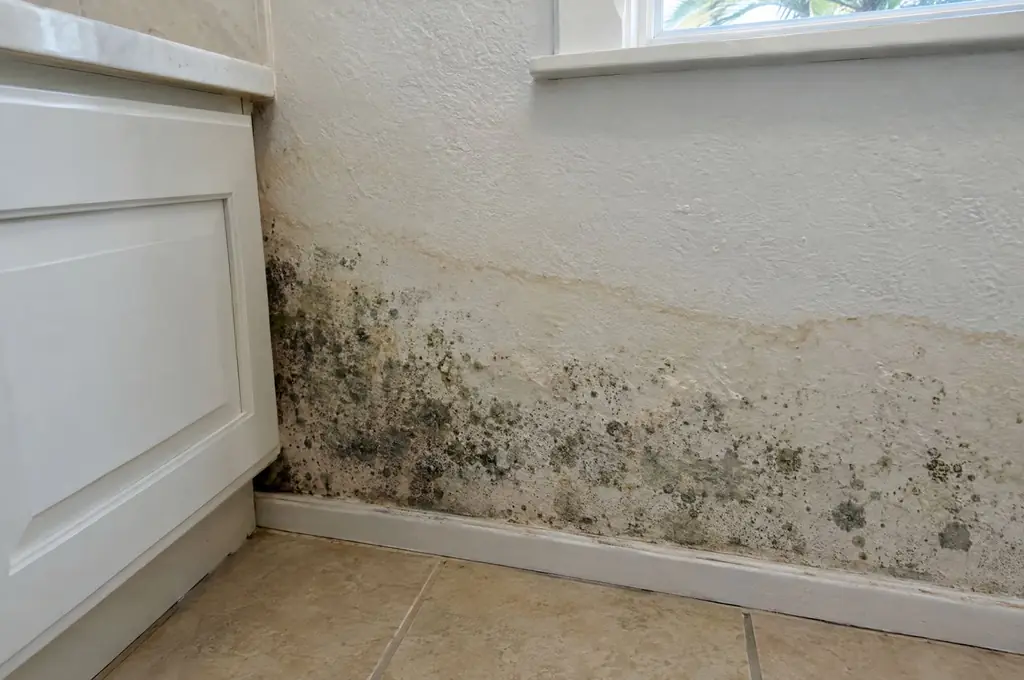
Most mold calls in San Diego trace back to a leak nobody saw: a supply line behind a vanity, a slab leak under laminate, or a window that sweats every morning when the marine layer sits on the coast. Bleach on the surface does not fix any of those. The moisture source has to stop first.
Because the state health department sets no license for mold work, the paperwork you can check is the contractor license for the repairs, the written scope, and the moisture readings showing the area is dry before the walls are closed.
Right now
- 1Stop the water if you can find it: close the angle stop under the sink or the house valve.
- 2Keep the door to the moldy room shut and don't run a fan that blows across the growth.
- 3Don't scrub or sand a large patch; the EPA says areas over about 10 square feet call for a professional.
- 4If the mold is near the heating or cooling system, leave the system off until it is checked.
- 5Take dated photos of the spots and of any water stain nearby.
San Diego facts for this problem
California has no legal requirement for training, licensing or certification of mold assessors or mold remediators, according to the state Department of Public Health.
A California contractor license is needed for any job of $1,000 or more, or any job that needs a building permit, including the repairs that follow mold removal.
Source: California Business and Professions Code 7048 (jobs under $1,000).
At San Diego International Airport, average relative humidity peaks in July at 75.2 percent (hourly readings 2016 to 2025).
Source: NOAA NCEI Local Climatological Data: San Diego International Airport (72290023188), calculated by San Diego Water Damage Watch on November 18, 2026.
December has the most damp hours at the airport: 35 percent of hourly readings at 80 percent relative humidity or more.
Source: NOAA NCEI Local Climatological Data: San Diego International Airport (72290023188), calculated by San Diego Water Damage Watch on November 18, 2026.
The EPA recommends keeping indoor relative humidity below 60 percent, and ideally between 30 and 50 percent.
Source: Mold, moisture and your home: the EPA's brief guide.
Census estimates for ACS 5-year 2020-2024 put about 53% of the homes in the 30 ZIP codes mostly inside San Diego city limits as built before 1980.
Source: U.S. Census Bureau, ACS 5-year, tables B25034 and B25035, calculated by San Diego Water Damage Watch on November 14, 2026.
California sets no license for mold inspectors or mold removal companies, the state health department says, so the check that matters is the CSLB license for any repair work of $1,000 or more or that needs a permit. Ask for the license number and look it up yourself.
Sources: CDPH Indoor Air Quality Section: Mold FAQ; California Business and Professions Code 7048 (jobs under $1,000); Contractors State License Board: Check a License
Related on this site: the San Diego humidity and mold guide for the damp months near the coast, and the flood map by ZIP for the age of the homes in each San Diego ZIP.
The job, step by step
Find the moisture
Meters and a thermal camera trace the wet area, which is often larger than the visible mold.
Your part: Say when you first saw the spots and any leak you know of.
Contain
Plastic sheeting and negative air keep spores from moving into the rest of the house.
Your part: Keep people and pets out of the sealed area.
Remove and clean
Moldy drywall, insulation or carpet that can't be cleaned comes out; framing is cleaned and dried.
Your part: Ask which materials come out and why, in writing.
Dry
Dehumidifiers and air movers run until the readings match dry material nearby.
Your part: Leave the equipment running and doors as set.
Repair
Drywall and finishes go back once the source is fixed and readings are dry. A job of $1,000 or more needs a CSLB-licensed contractor.
Your part: Look up the license number before repairs start.
How insurance usually treats it
The California Department of Insurance lists mold, and water damage from seepage or leaks, among the losses homeowners policies generally exclude. It also says mold damage caused by a covered peril may be covered, which is why the cause and its timing matter. Your policy's own wording decides.
General information, not insurance advice; the policy itself decides. More on the California water damage insurance page.
What changes the size of the job
- Square footage of growth and how much material has to come out
- Whether the moisture source is still active
- How the work area will be sealed off from the rest of the home
- Days of drying before repairs can start
- Repairs to drywall, cabinets or flooring afterward
No prices on this site. A company measures moisture on site and writes an itemized estimate; the water damage estimator lists what that estimate should include.
Questions people ask about mold remediation
Does California license mold remediation companies?
No. The California Department of Public Health says there is no legal requirement in California for licensing, training or certification of mold assessors or remediators. The repairs are construction, so a job of $1,000 or more, or one needing a permit, requires a CSLB-licensed contractor.
What size of mold patch is a homeowner job?
The EPA puts the line at about 10 square feet, roughly a 3-foot by 3-foot patch. Larger areas, mold after heavy water damage or sewage, and mold inside a heating and cooling system are jobs for an experienced professional.
I rent in San Diego and there is mold. What can I do?
Tell your landlord in writing with dated photos. Under California's Health and Safety Code, visible mold growth found by a health or code enforcement officer makes a rental substandard, apart from minor mold on surfaces that get wet in normal use.
Sources for this page
- CDPH Indoor Air Quality Section: Mold FAQ
- California Business and Professions Code 7048
- Contractors State License Board: Check a License
- EPA: Mold Cleanup in Your Home
- Mold, moisture and your home: the EPA's brief guide
- California Department of Insurance: Residential Insurance, Homeowners and Renters
- California Department of Insurance: Residential Property Claims Guide
- California Health and Safety Code 17920.3